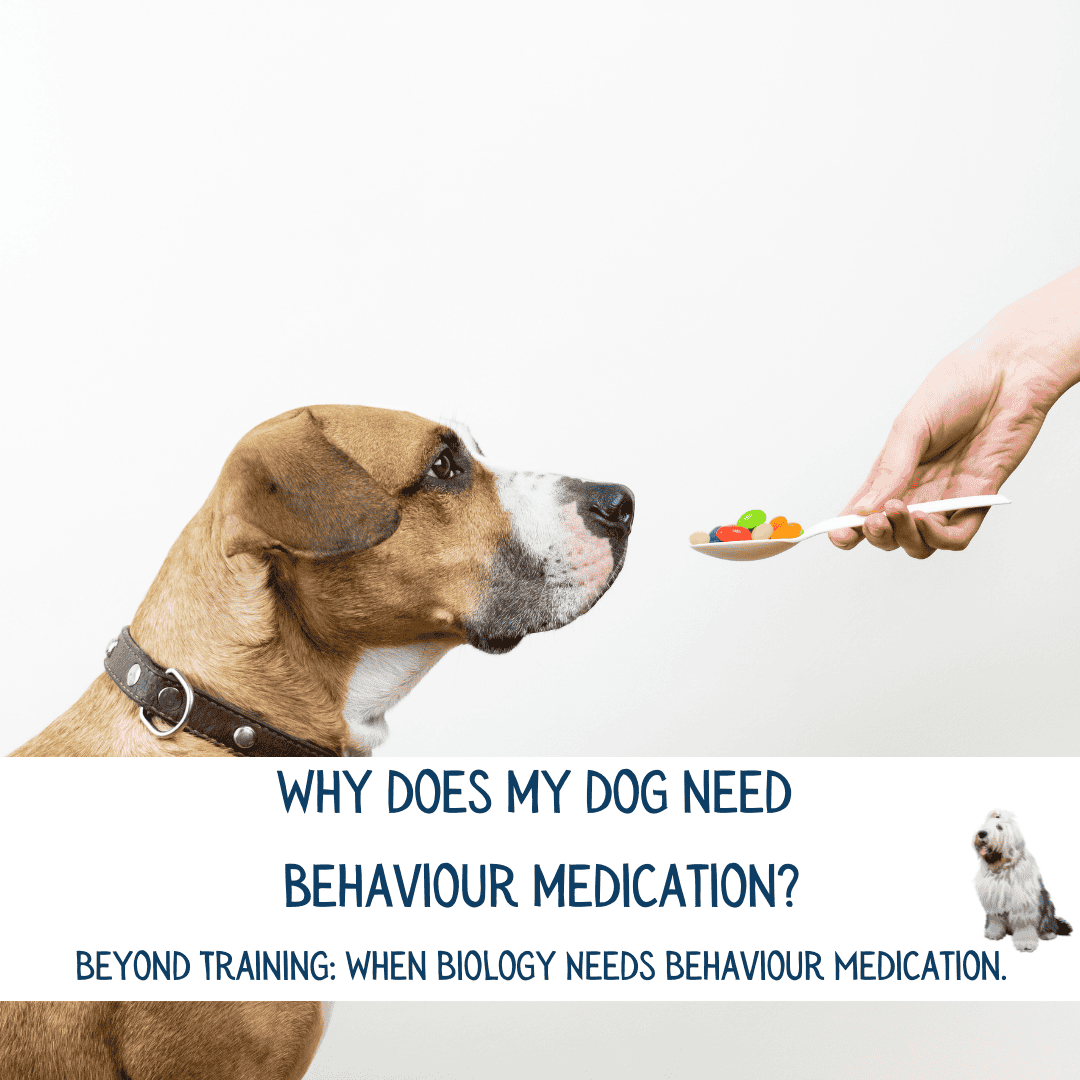
Beyond Training: When Biology Needs Behaviour Medication.
As a dog behaviourist in Edinburgh, I frequently work with foreign rescue dogs and reactive dogs who are perpetually stuck in a state of “high alert”. For many of these dogs, the transition from a street dog to a city companion is a massive neurological leap. While you might assume that providing a life of comfort should make your dog feel instantly happy, it doesn’t work like that from your dog’s perspective. They’ve been taken away from their ‘normal’, making city life scary.
While my 1-2-1 bespoke programmes focus on a holistic approach assessing sleep, diet, gait, and posture there is one topic that often carries an unnecessary weight of “owner guilt”: behaviour medication.
Many dogs with the right management and behavioural support can overcome their state of ‘high alert’. However, some dogs may require medication to remain calm and learn and adapt. It is time to shift the conversation. Behaviour Medication is not a failure of training; often, it is the very foundation that makes training possible.
The “Fire Drill” Brain
Imagine trying to learn a complex new skill while standing in a building with a fire alarm blaring. No matter how calm the teacher is or how high-quality the rewards are, your brain is physically incapable of processing new information because it is focused entirely on survival.
For many foreign rescue dogs, their neurochemical system is in a constant “fire drill”. Research on veterinary behaviour indicates that chronic stress induces physiological changes in the brain.
Prolonged exposure to cortisol (the stress hormone) causes physical changes in brain structures. In reactive or anxious dogs, the amygdala, the brain’s “alarm system” can become overactive and enlarged, while the prefrontal cortex the “rational” part of the brain can undergo atrophy. This creates a dog that is “all reaction and no reflection. (McEwen, B. S. 2005).1
When a dog’s system is flooded with stress chemicals, the hippocampus (responsible for memory and learning) is inhibited. (Schilder, M. B., & van der Borg, J. A. 2004).2
In many former street dogs or foreign rescues, a history of trauma can lead to permanently low levels of serotonin. (Amat, M., et al. 2013)3. Training cannot “fix” a lack of neurotransmitters any more than it can fix a broken leg.
I use this science to ensure we aren’t just “training over the top” of a biological problem By looking at your dog’s diet, sleep, and posture, we aim to stabilise the biology so the training can finally take hold.
Medication as a Stabiliser, Not a Shortcut
It is vital to understand that challenges such as reactivity, fear, and hyper-vigilance are deeply rooted in a dog’s emotional state. Because these are emotional responses rather than simple “bad habits,” they cannot be “trained” away through traditional commands alone.
Instead, we must identify the underlying reason and the specific emotion(s) driving the behaviour. This is why every dog I work with begins their journey with a “deep dive” assessment, a 90-minute session where we analyse every aspect of their life to build a foundation for true, lasting confidence. If the assessment indicates a need for Behaviour medication and support, it is always provided in collaboration with a supporting veterinarian.
According to studies on psychoactive medication in canines (such as Crowell-Davis et al.)4, these “B-meds” act as neurological stabilisers. They help with:
- Fear Processing: Reducing the “volume” of the world’s threats. Imagine your dog’s fear is like a loud, startling noise. When a dog’s system is dysregulated, every “threat” a cyclist on the Meadows or a bin bag flapping in the wind feels like a shout.
- Medication helps turn that shout into a whisper. It doesn’t stop the dog from noticing the world, but it reduces the intensity of their internal alarm.
- Medication helps turn that shout into a whisper. It doesn’t stop the dog from noticing the world, but it reduces the intensity of their internal alarm.
- Impulse Control: Giving the dog a split second to think before reacting. Reactive dogs often live in a “reflex” state. There is no middle ground between seeing a trigger and reacting.
- We want to build a “buffer” between the trigger and the reaction. This “split second” is where learning happens.
- We want to build a “buffer” between the trigger and the reaction. This “split second” is where learning happens.
- Emotional Regulation: Helping the dog return to a calm state faster after a trigger. One of the biggest struggles for former street dogs is “trigger stacking” where one stressful event ruins their mood for the rest of the day.
- We want to help the dog’s nervous system reset efficiently so they don’t stay “on guard” for hours after a walk
- We want to help the dog’s nervous system reset efficiently so they don’t stay “on guard” for hours after a walk
- Pain Modulation: Assisting when underlying physical discomfort is driving the behaviour. I always review gait and posture because behaviour and physical comfort are inextricably linked
- If a dog is in chronic low-level pain (perhaps from a long journey from overseas or poor early-life nutrition), they have a much shorter fuse for frustration
- If a dog is in chronic low-level pain (perhaps from a long journey from overseas or poor early-life nutrition), they have a much shorter fuse for frustration
Remember, some dogs can achieve these without the need for behaviour medication. Every dog is unique and an individual, so what works for one dog won’t necessarily work for the next dog.
It’s Not a Last Resort
In my practice, I often encounter the belief from owners that medication should be a “last resort”, something to be explored only when every training technique has been exhausted. However, when we look at the neurobiology of a former street dog or a highly reactive dog, we see that biology often dictates the pace of learning.
When a dog’s neurochemical system is dysregulated, they are essentially living in a state of survival. Expecting a dog in this state to learn new behaviours is like asking a human to solve a complex math problem while in the middle of a panic attack.
- The Learning Threshold: Training is about creating new neural pathways. If a dog is constantly above their “threshold” due to a chemical imbalance, those pathways cannot form. Medication lowers that threshold, allowing the dog the capacity to learn.
- The First Step, Not the Final One: For many dogs, medication acts as a “chemical floor”. It stabilises their internal environment so that their behaviour and training plan can actually be processed by the brain.
Research and experts in this area include Dr. Karen Overall (Manual of Clinical Behavioral Medicine for Dogs and Cats), Dr. Christopher Pachel: A renowned veterinary behaviourist and Daniel Mills research (The Psychobiology of Behaviour. 2013).5
Why We Can’t “Train” Away Biology
We must be realistic: we cannot expect a dog to “learn” their way out of a neurochemical imbalance any more than we would expect a human to “think” their way out of a broken leg.
- Training is one part of the process: It provides the “how-to” for the dog.
- Biology is the foundation: It provides the “ability-to”.
- Holistic Support: This assesses the whole dog including sleep, diet, and functional movement, before we even pick up a treat to start training.
By treating the biological root alongside the behaviour, I can help and support the humans and their dogs with the best possible chance of enjoying those walks up the Munros or visits to local cafes.
A Professional Partnership
It is essential to recognise that unless there is a thorough understanding of a dog’s unique case history, emotional baseline, and physical health, it is impossible to judge whether behaviour medication is “necessary.” Making such a decision requires an insightful, in-depth analysis rather than a quick judgment.
If medication is used, it should be carefully monitored and always implemented in conjunction with a bespoke behaviour plan. While pharmacological support can offer positive neurological stabilization, it is not a “magic fix” on its own; it will not undo the habits or behaviours a dog has already learned and practiced. Medication simply creates the biological foundation that allows our training and management to finally be effective.
At Edinburgh Holistic Dogs, I provide the emotional support and the bespoke training plan, but I never advise on specific behaviour medications without veterinary expertise. I work with the human, the behaviourist, and the vet to ensure the dog has the best possible chance of a happy, relaxed life in Edinburgh.
Choosing to support your dog’s biology isn’t giving up it’s giving them the clarity they need to finally hear what you’re trying to teach them.
Below are common “Red Flags” that suggest a dog may be struggling with a dysregulated neurochemical system rather than a lack of training.
1. Hyper-Vigilance and the “No-Go” Zone
- The Sign: Your dog cannot settle, even in a quiet home environment, and constantly scans the windows or doors for “threats”.
- The Biology: This indicates an overactive amygdala, where the dog’s brain is stuck in a permanent state of “search and rescue” for danger.
2. The “Recovery Lag”
- The Sign: After seeing a trigger (like another dog), it takes your dog hours—or even days—to return to their normal self.
- The Biology: This is often a sign of adrenal flooding. If a dog cannot “shake off” a stressful event quickly, their baseline stress levels remain high, making them more likely to react to the next small thing (trigger stacking).
3. Inability to Take Food or Rewards
- The Sign: In the presence of a trigger, your dog refuses even high-value treats (like chicken or cheese) that they would normally love.
- The Biology: When the sympathetic nervous system (fight or flight) takes over, the digestive system effectively shuts down. If they can’t eat, they aren’t in a “learning state.”
4. Extreme Impulsivity (The “Zero to Sixty” Reaction)
- The Sign: Your dog has no “middle ground”; they go from calm to an explosive reaction in a split second with no warning growl or body language.
- The Biology: This suggests a lack of serotonin or poor prefrontal cortex function, which are responsible for “braking” impulses.
5. Paradoxical Reactions or “Over-the-Top” Play
- The Sign: Play quickly turns into frantic, obsessive, or aggressive behaviour where the dog seems “possessed” and unable to stop.
- The Biology: This often stems from a dysregulated dopamine system, where the dog becomes “hooked” on the high-arousal state and loses the ability to self-regulate.
If you would like help with your rescue dog or reactive dog, book a free call HERE.
Suzanne Gould. Canine Behaviourist and Dynamic Dog Practitioner.
References.
- McEwen, B. S. (2005). “Glucocorticoids, depression, and fertility: issues for the clinician ↩︎
- Schilder, M. B., & van der Borg, J. A. (2004). “Training dogs with help of the shock collar: short and long term behavioural effects. ↩︎
- Amat, M., et al. (2013). “Serotonin in canine aggression ↩︎
- Crowell-Davis, S. L., & Murray, T. (2006). Veterinary Psychopharmacology ↩︎
- Mills, D., Braem, M. and Zulch, H. (2013). The Psychobiology of Behaviour. ↩︎